

In short. A mobile or trailer generator changes its electrical and physical environment with every deployment, so mobility is an engineering parameter, not a chassis option. Each new site brings a different load, cable length, earthing arrangement, connection point, ground condition and ambient. The set may be unchanged between projects, but voltage drop, fault current, protection, earthing and placement must be checked again every time it moves, or the convenience of mobility becomes a safety problem.
What mobile means in practice
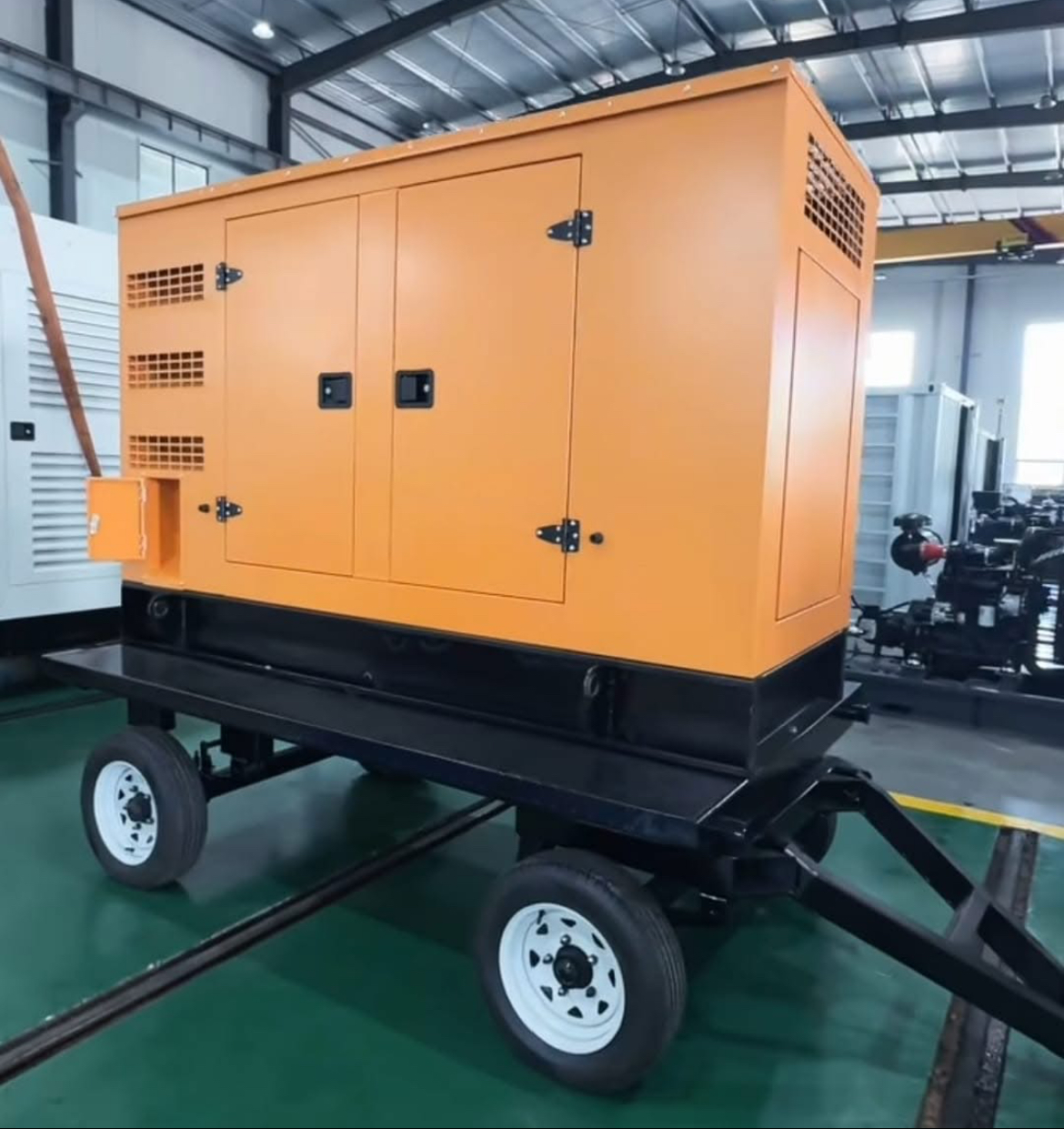
Three configurations are usually grouped under the heading. A trailer-mounted set is built on a road-towable chassis with axles, brakes and lighting, in the range of roughly 15 to 500 kVA, and moves behind a vehicle. A skid or containerised set can be lifted and transported on a truck but is not towed, and covers larger ratings. A truck-mounted set is fixed to a vehicle for rapid response. The word mobile should not suggest that any generator can be put on wheels and moved: transport suitability depends on the specific unit’s mass, dimensions, lifting points and the applicable road rules. Mobile sets serve construction, infrastructure, maintenance outages, remote work, commissioning, events and emergency response, and most are rented rather than owned; a set that will stay in one place for years is better specified as a stationary set. The mobile generator rental page covers that route.
| Check before every deployment | What changes between sites | Consequence if skipped |
|---|---|---|
| Electrical connection | Voltage, phase sequence, connection point, upstream protection | Reverse rotation of motors, wrong breaker coordination |
| Load | Running kW, largest motor start, nonlinear content | Voltage dip, tripping, overheated alternator |
| Cable run | Length, size, route, mechanical exposure | Voltage drop, cable damage, earth faults |
| Earthing | Soil, available electrode, bonding to the installation | Protection does not operate, touch voltage hazard |
| Position | Ground bearing, level, exhaust clearance, airflow | Overheating, fumes into buildings, trailer movement |
| Fuel | Hours of running, refuelling access | Set runs dry at the worst moment |
Every site is a new earthing question
A fixed generator is earthed once and tested. A mobile set is connected to a different earth at every site, and the quality of that earth decides whether the protection works and whether a damaged cable becomes a shock hazard. The set’s neutral should be earthed at the generator by a driven electrode with a measured resistance, or bonded to the installation’s existing earth when the set feeds a building’s switchboard, and the frame bonded to the same point. Which arrangement is right depends on whether the set feeds a stand-alone temporary installation or an existing one, and on whether the existing supply neutral is still connected. A remembered earth resistance figure from the last site is no use at the next one. Residual current protection on all final circuits is the practical safeguard where the earth path is uncertain. The earthing guide explains the arrangements for each case.
Long cables, voltage drop and fault current
Mobile sets are often placed where they can be reached by the towing vehicle, which may be 100 or 200 metres from the load. Over that distance a flexible cable sized for current alone may drop voltage well beyond the 3 to 5 per cent that motors and electronics tolerate, and the generator’s own limited fault current, typically around three times rated current sustained for a few seconds, may not be enough to trip a downstream breaker through the cable impedance.
Voltage drop (V) = √3 × I × L × (R cos φ + X sin φ)
I is the load current in amperes, L the one-way cable length in kilometres, R and X the cable resistance and reactance per kilometre, and cos φ the load power factor. For 150 A at 0.85 power factor over 150 metres of 50 mm² copper, with R near 0.39 and X near 0.08 ohms per kilometre, the drop is about 15 V, or 3.6 per cent at 415 V (illustrative), which is close to the limit before any motor starting is considered. The voltage drop guide and the temporary cable page cover sizing and routing.
Towing, placement and the physical site
Transport introduces requirements that have nothing to do with electricity: gross trailer mass and the towing vehicle’s rating, brakes and lighting, registration where the road rules require it, and lifting points and slinging for skid sets. On site, the trailer must stand on firm, level ground, chocked and with the jockey wheel and stabilisers down, clear of excavations and traffic, with the radiator discharge and exhaust pointing away from buildings, tents and people and with free airflow around the canopy. Security matters because mobile sets are stolen and tampered with; a fenced compound with the fuel inside it is the norm on longer deployments. Repeated redeployment also wears the set differently from fixed duty: door seals, cable glands, battery terminals and fuel connections loosen with road vibration and need a check at each arrival.
Load, protection and fuel on the move
The load at a new site must be assessed as if the set were being selected fresh. Motors, drives, welders and UPS behave differently from the resistive loads the rating implies, and a set that served an office cabin well may be wrong for a pumping station. Protection settings that suited the previous site’s cable and load should be reviewed for the new one, and the connection to an existing installation must prevent any possibility of back-feeding the grid, which means an interlocked changeover rather than a plug into a socket. Fuel is planned per deployment: the integral tank of a trailer set typically gives 8 to 12 hours at 75 per cent load, so longer jobs need an auxiliary tank or a refuelling arrangement. The generator sizing guide applies in full to each new deployment, and the generator systems overview explains the selection chain it follows.
Related photographs and videos
Common mistakes
- Connecting the set without earthing it because the job is only for a day. A damaged lead becomes a shock hazard and residual current devices behave unpredictably.
- Reusing a cable drum sized for a previous short run on a 200 metre run. Voltage drop trips motor contactors and the generator is blamed.
- Plugging a mobile set into an installation without an interlocked changeover. The set back-feeds the DISCOM line and endangers linesmen.
- Parking the trailer against a wall or under a canopy for shade. Hot air recirculates into the radiator and the set shuts down on temperature.
- Assuming the integral tank covers the shift. The set stops at night and the pump or lighting it served goes with it.
What to send us
Send the load list for the deployment with the largest motor and its starting method, the distance from where the set can stand to the connection point, and whether the set will feed a stand-alone temporary installation or an existing switchboard. Add the daily running hours, the duration of the job, the site access for a towing vehicle or crane, and photographs of the connection point and the ground where the set will stand. Send your mobile generator requirement.
Questions engineers ask
Does a trailer generator need to be earthed at every site?
Yes. The neutral and frame must be earthed at each deployment, either by a driven electrode with a measured resistance or by bonding to the installation’s existing earth, depending on how the set is connected. Earthing from the previous site does not travel with the trailer.
How far can a generator be placed from the load?
As far as the cable can carry the current within about 3 to 5 per cent voltage drop and still allow the protection to trip on a fault at the far end. For a 125 kVA set this is typically 100 to 200 metres with properly sized copper cable, and longer runs need larger cable or a closer position.
Can I plug a mobile generator into my building supply?
Only through an interlocked manual changeover or an automatic transfer switch that isolates the grid supply first. A direct connection can back-feed the DISCOM network, which is dangerous to linesmen and illegal under the CEA regulations.
What size trailer generator can be towed by a pickup?
It depends on the towing vehicle’s rated capacity and the trailer’s gross mass. Sets up to roughly 60 to 100 kVA on a single or tandem axle trailer are commonly towed by light commercial vehicles; above that a truck or a flatbed transport is usually needed. Confirm the specific unit’s mass against the vehicle rating.
Generators by rating
- Under 15 kVA generators
- 15–50 kVA generators
- 50–125 kVA generators
- 125–250 kVA generators
- 250–500 kVA generators
- 500–1000 kVA generators
- 1–2 MVA generators
- 2 MVA and above generators
Technical content reviewed by Srinivas Reddy, Managing Partner, Reddy Generators. Last updated 19 October 2026.