

In short. Reddy Generators services diesel generators of all makes in Hyderabad, Secunderabad and across Telangana and Andhra Pradesh, from the first application assessment through installation, commissioning, preventive maintenance and AMC, to breakdown diagnostics, engine and alternator overhaul and replacement planning. The right service depends on what decision you need to make, so send the set’s identity, hours and the symptom or objective and we will scope the visit properly.
Service follows the lifecycle of the set
A generator passes through the same stages whether it is a 15 kVA set behind a clinic or a 1,500 kVA machine at a pharmaceutical plant in Jeedimetla: establish what the load needs, confirm the site can take the equipment, install and commission it, keep it ready through years of occasional use, diagnose it when it misbehaves, and eventually decide whether to overhaul or replace it. Since 2002 we have found that most expensive failures trace back to a stage that was skipped: a set installed without a site survey, commissioned with a no-load run only, or maintained on an AMC that never included a loaded test.
The service pathways
| Stage | What it answers | Typical trigger | Service pages |
|---|---|---|---|
| Application assessment and load study | What does the process actually need, in kW, kVA, transients and duty? | New facility, expansion, set tripping on load | Application assessment, load study |
| Site survey and design support | Can the set be placed, ventilated, exhausted, fuelled, connected and maintained here? | Before quotation or civil work | Site survey, design support |
| Installation planning, installation, commissioning | Is the installed system proven against the design before it is relied on? | Delivery scheduled, handover due | Installation, commissioning |
| Preventive maintenance and AMC | Will it start and carry load at the next outage? | Every 250 to 500 hours or six months, whichever first | Preventive maintenance, AMC |
| Breakdown and root-cause diagnostics | Why did it fail, and what stops it failing again? | No start, trip on load, alarms, smoke, vibration | Breakdown diagnostics |
| Engine, alternator, overhaul, refurbishment | Is repair economical, and to what standard? | High hours, blow-by, low insulation resistance | Engine service, alternator service |
Preventive maintenance: what a proper visit covers
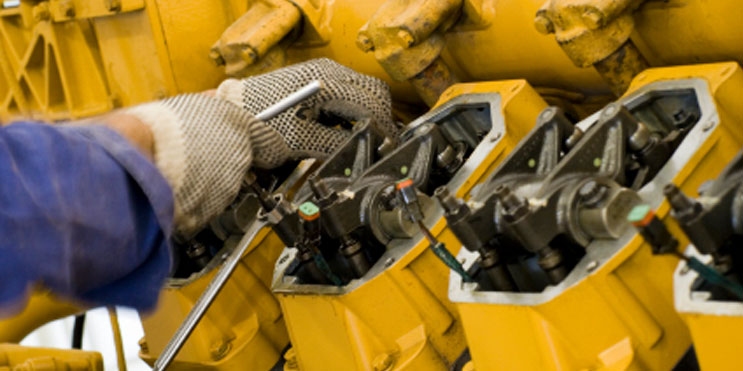
A preventive maintenance visit is not a glance and an oil top-up. It is a structured check of the engine, alternator, controls, fuel, cooling, starting system and the installation around the set, with measurements recorded against the previous visit. On a standard visit we record running hours, battery voltage and charger output, oil pressure and coolant temperature at load, exhaust colour, coolant inhibitor strength, fuel separator drain, belt tension, air filter restriction, alternator insulation resistance where due, AVR settings, the controller alarm log, and the state of the room or canopy including louvres and recirculation. Oil and filter changes follow the engine maker’s hours and calendar intervals, and in dusty Telangana sites air filters usually need attention before the hours interval. The visit ends with a load run, on building load or a load bank, because a set that only ever idles for ten minutes a week develops wet stacking and glazed liners.
AMC: what should be in writing
An annual maintenance contract is useful only when its scope is specific. The contract should name the sets by make, model, serial number and rating, state the number of scheduled visits and the checklist for each, define what consumables and filters are included and whether they are genuine parts, state who supplies and approves non-routine parts, set a response time for breakdown calls that is realistic for the location, and say whether a loaded test and a report are part of each visit. Response terms are subject to location, access, technician availability and parts, and a contract that promises otherwise is not being honest. Our generator AMC page sets out the tiers we offer and what each includes.
Breakdown support and diagnostics
Breakdown service begins with triage over the phone. The questions are simple: does it crank, does it fire, does it run and trip, and what does the controller display say. A no-crank fault is nearly always battery, charger or starter; a crank-no-start fault is usually fuel, air or the stop solenoid; a trip on load points to overload, cooling, fuel delivery, AVR or protection settings. Knowing this before the technician leaves Tarnaka decides which parts go in the van. On site, modern diagnostics convert symptoms into causes by reading controller event logs, measuring rather than assuming, and checking the installation around the set before condemning a component. Bypassing a protection to restore power is never the fix; it converts a trip into an engine or alternator failure. Repeat failures go to root-cause diagnostics, and the self-help guide at generator troubleshooting lists what to check before calling.
Repair, overhaul and the economics of old sets
Engine repair should follow inspection and measurement: compression or blow-by, oil analysis, liner and bearing inspection, and valve condition decide between a top overhaul, a major overhaul or continued running. Alternators are judged on insulation resistance, polarisation index, bearing condition and winding temperature, and rewinding is a defined service rather than a last resort. Repair stops being economical when the set is pre-CPCB norms and needs an emission retrofit, when parts for the engine family are scarce, or when the overhaul cost approaches a meaningful fraction of a new CPCB IV+ set. We will say so when that is the case, and set out the comparison over a five-year horizon.
Parts and the service record
Service quality depends on the parts fitted. We supply genuine and verified-compatible parts for Cummins, Kirloskar, Mahindra, Perkins, CAT, FG Wilson, Greaves, Eicher and other engine families, identified from the engine serial number rather than from a photograph of an old filter; see generator spare parts. Every visit, scheduled or breakdown, should leave a record that holds the equipment identity, hours, symptoms reported, condition found, measurements, work done, parts used, how the result was verified and what remains outstanding. A record that says only serviced is of no use to the engineer who attends the next fault at midnight.
Related photographs and videos
Common mistakes
- Signing an AMC that specifies visits but not a checklist or a loaded test; the set is wiped and signed off for years and fails at the first real outage.
- Testing the set weekly at no load for ten minutes; unburnt fuel and carbon build up, the exhaust weeps black oil and the engine loses compression.
- Replacing parts in sequence until the fault goes away; the bill grows, the record is useless and the cause is never known.
- Resetting or raising a protection setting to keep the set running; the trip was protecting the engine or alternator, and the next event is a failure instead of a trip.
- Ignoring the installation during service; a blocked louvre, a water-filled separator or a tired battery charger causes more outages than the engine does.
What to send us
Send a photo of the engine, alternator and controller nameplates, the running hours, the site location, the last service date if known, and either the fault description with the controller alarm text or the service objective. Photos of the room or canopy, the batteries and the fuel separator help us arrive with the right parts. Use the service and AMC enquiry, or for spares the spare parts enquiry.
Questions engineers ask
How often should a standby diesel generator be serviced?
Follow the engine maker’s intervals, which are typically every 250 to 500 running hours or every six months, whichever comes first, for oil, filters and a full check. A standby set that runs few hours still needs the calendar-based visit because oil, coolant, belts, batteries and fuel degrade with time rather than hours.
Do you service generators of all makes?
Yes. We work on Cummins, Kirloskar, Mahindra, Perkins, CAT, FG Wilson, Greaves, Eicher and other diesel engines with their alternators and controllers, using parts identified from the engine serial number. We sell these makes through our supply tie-ups and bring two decades of field experience with these machines.
What is included in a generator AMC?
A good AMC names the sets, fixes the number of visits and the checklist for each, states which consumables and filters are included, defines breakdown response and parts responsibility, and includes a loaded test and a written report per visit. Anything not written down should be assumed excluded.
My generator starts but trips when the load comes on. What is wrong?
The usual causes are overload or a large motor start, a cooling restriction, fuel starvation from a blocked filter or air leak, an AVR or excitation fault, or a protection setting that is wrong for the installation. Read the controller trip code first; it narrows the search considerably.
We serve all of Telangana and Andhra Pradesh and every district within about 300 km of Hyderabad, with project support across India. See the areas we serve.
Technical content reviewed by Srinivas Reddy, Managing Partner, Reddy Generators. Last updated 19 October 2026.