

In short. Preventive maintenance on a diesel generator is a scheduled programme of inspection, servicing and testing driven by running hours, calendar time and observed condition, not by breakdowns. A standby set that runs twenty hours a year still needs it, because batteries, fuel, coolant, belts and seals deteriorate while the machine stands idle. The aim is a documented picture of condition and a machine that starts and carries its load at the next outage.
Standby generators age even when they do not run
The most common misunderstanding we meet in Hyderabad is that a generator with 300 hours on the meter after five years is “as good as new”. The engine may well be. The systems around it are not. Lead-acid starting batteries lose capacity with age and with the heat of a Telangana summer regardless of use. Diesel stored in a day tank picks up water through breathing and condensation during the monsoon, and that water feeds microbial growth that blocks filters. Coolant additives deplete with time. Rubber hoses and belts harden.
So the maintenance basis for a standby set is calendar time with running hours as a second trigger, whereas a prime-power set on a construction site or in a rice mill is driven mainly by hours. The plan must be written for the duty the generator actually has, starting from the engine manufacturer’s intervals rather than a checklist copied from another contract. The broader planning logic is set out in maintenance planning.
What a preventive visit actually covers
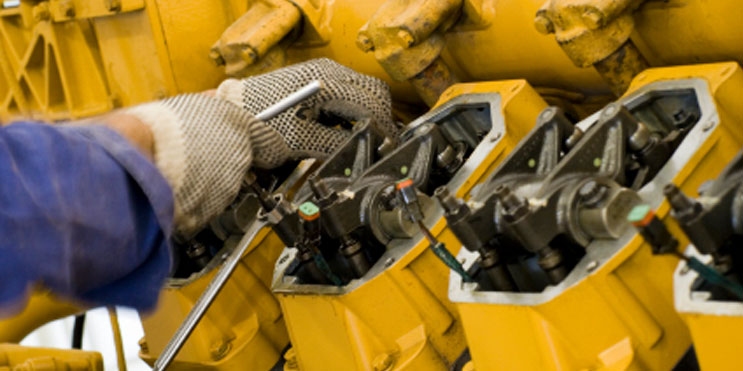
Changing oil and filters is the visible part of a service, but a small part of what decides whether the set will start at 2 a.m. during a DISCOM failure. A complete visit works through every system the next start depends on.
| System | Typical checks | Why it matters |
|---|---|---|
| Starting and charging | Battery voltage, specific gravity or conductance, terminal condition, charger output, cranking speed | Battery failure is the single most frequent cause of a standby set not starting |
| Fuel | Tank level, water drain, filter condition, leaks, transfer pump, fuel sample from tank bottom | Water and sludge cause filter blocking and injector damage |
| Lubrication | Oil level and condition, leaks, oil pressure at running temperature, filter change at interval | Low oil pressure is the shutdown most likely to end in a seized engine |
| Cooling | Coolant level and concentration, hoses, belts, fan, radiator fins, thermostat operation, room airflow | Overheating under load is often a room problem rather than a radiator problem |
| Air and exhaust | Air filter restriction indicator, intake hoses, exhaust leaks, rain cap, silencer condition | A restricted intake causes smoke, power loss and turbocharger stress |
| Alternator and output | Voltage, frequency, phase currents, AVR behaviour, terminal tightness, insulation resistance when due | Loose terminals and damp windings fail under load, not at idle |
| Controls and transfer | Alarm log review, simulated mains failure, transfer and retransfer timing, mode selector in auto | The AMF sequence is the function the customer actually relies on |
| Installation | Louvres, ducting, earthing connections, cable glands, fuel and oil spillage, vermin | Blocked louvres and nested rodents are found at nearly every neglected site |
A practical interval structure for Indian conditions
Engine manufacturers publish intervals and those govern warranty, so what follows is a typical structure rather than a specification. Different checks belong to different people and frequencies.
Weekly, by site staff
A visual walk-round, charger lamp, fuel, coolant and oil levels, no leaks under the set, controller in auto with no active alarms, and a short no-load run of ten to fifteen minutes. Record the hour-meter and controller readings in a log; a change from last week is more informative than the absolute value.
Monthly, by site staff or a technician
A run on load for thirty minutes or more, ideally through the real transfer sequence, with voltage, frequency, current and temperatures logged. Drain water from the fuel filter bowl and tank. Check belt tension, the air filter indicator and the louvres.
Six-monthly or 250 hours, by a service engineer
Oil and filter change where the interval is reached, fuel filter change, coolant test, battery load test, valve clearance where scheduled, alternator insulation resistance, terminal tightening and a review of the controller alarm history. This is the visit where developing problems are usually caught.
Annually
Everything in the six-monthly visit plus a load bank or full-site load test to rated or near-rated output, coolant replacement where due, a check of protection settings against the commissioning record, and a written condition report with recommendations. Many customers fold this into a generator AMC so the dates are not missed.
Why a no-load run proves very little
A generator that idles each week is reassuring but not demonstrated. Off load the engine never reaches full operating temperature, so a weak cooling system, a marginal turbocharger or an injector that misfires under pressure stays hidden. Prolonged no-load running also causes wet stacking, where unburnt fuel and carbon collect in the exhaust and on the valves. The weekly run should be short, and at least monthly the set should carry real load, roughly thirty percent of rating or more, until temperatures stabilise. Where the site load is small or cannot be transferred, periodic load bank testing is the substitute.
Records turn maintenance into evidence
A service visit without a report is money spent and knowledge lost. Each visit should leave behind the running hours, the work done, parts fitted with part numbers, measured values, alarms found in the controller log and prioritised recommendations. Over two or three years that file shows trends: oil consumption creeping up, battery voltage recovering more slowly after cranking, coolant temperature on load rising each summer. Those trends allow an overhaul or a radiator clean to be planned rather than forced, and they tell the troubleshooting engineer what was normal for that machine. Consumables and filters for the schedule are covered under generator consumables.
Related photographs and videos
Common mistakes
- Replacing only the one battery that reads low in a two-battery 24 V set, which leaves a new battery paired with a tired one and shortens the life of both.
- Treating the weekly no-load run as a load test, so the first time the set sees real current in a year is during an actual outage.
- Topping up coolant with plain borewell water repeatedly, which dilutes the inhibitor and scales the radiator core.
- Ignoring a charger fault lamp for weeks, which usually ends as a flat battery on the night the mains fails.
- Using a generic interval sheet instead of the manufacturer’s schedule for the installed engine, which can void warranty and miss items such as valve clearance.
What to send us
To propose a maintenance plan we need the generator make and rating, photographs of the engine, alternator and controller nameplates, the current hour-meter reading, the approximate hours run per year, the last service date and any existing service reports or recurring alarms. A photograph of the generator room from the door tells us a lot about ventilation and access. Send these through the service and AMC enquiry form.
Questions engineers ask
How often should a standby diesel generator be serviced?
Most engine manufacturers specify an oil and filter change at around 250 running hours or six to twelve months, whichever comes first. For a standby set in India that rarely reaches 250 hours, a six-monthly engineer visit with weekly site checks is a reasonable baseline, confirmed against the manual for the installed engine.
How long should the weekly test run be?
Ten to fifteen minutes off load is enough to confirm starting, charging and oil pressure without causing wet stacking. The run that proves the machine is the monthly run on load, which should be long enough for coolant temperature to stabilise, typically thirty minutes or more.
Does preventive maintenance matter for a CPCB IV+ generator?
More, not less. CPCB IV+ sets use electronic fuel injection and aftertreatment that are sensitive to fuel quality, oil specification and correct operating temperature. Running them on contaminated diesel or the wrong oil grade can damage emission components that are expensive to replace, so the fuel and oil items on the schedule carry extra weight.
What should a service report contain?
Hour-meter reading, work performed, parts and consumables with part numbers, measured values such as battery voltage, oil pressure, coolant temperature on load, output voltage and frequency, the alarm log summary, and prioritised recommendations. A report that only says “serviced, found OK” has no value when a fault is investigated later.
Can our own electrician do the maintenance?
Site staff can and should do the weekly and monthly checks, the log entries and the water draining. Oil and filter changes, valve adjustment, insulation testing, controller configuration review and anything involving fuel injection or protection settings need a trained generator technician with the right tools and the manufacturer’s data.
Technical content reviewed by Srinivas Reddy, Managing Partner, Reddy Generators. Last updated 19 October 2026.