

In short. A major overhaul strips a diesel generator engine to renew the wearing parts of the bottom end and top end together: pistons, rings, liners, bearings, seals and gaskets, plus whatever the measured condition of the crankshaft, block, heads, oil pump and injection equipment requires. The scope is set by inspection against the manufacturer’s limits, not by a kit list, and the choice between overhaul and replacement rests on condition, parts support and future duty.
What makes an overhaul “major”
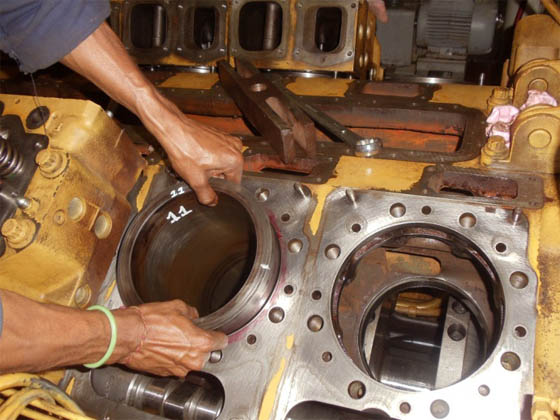
The word describes depth, not a fixed parts list. A major overhaul reaches the crankshaft. The engine is drained, the heads, sump, pistons and liners come out, the crankshaft is measured in place or removed, and every wearing surface is compared with the manufacturer’s published limits. On many generator engines this can be done with the block left on the baseframe; on larger engines, or where the site has no clean space, the engine is removed to a workshop. The distinction from a top overhaul is simply that the pistons, liners and bearings are renewed and the crankshaft is assessed.
The trigger is normally evidence that the bottom end is worn: high blow-by from the breather, oil consumption that a top overhaul would not cure, low oil pressure at temperature with a healthy pump, bearing material in the oil analysis, a knock, or a failure such as a dropped valve or seized piston that has damaged more than one cylinder. Running hours are part of the picture, but we have seen prime-power engines past their guide hours in good measured condition and standby engines ruined at a fraction of them by water in the fuel.
Scope is set by measurement, not by the kit
Overhaul kits are convenient for ordering and the source of two opposite errors. One is to fit the kit and nothing else, leaving a worn crankshaft journal in a rebuilt engine. The other is to inflate the scope with every component that could be replaced, so a serviceable oil pump is changed to make the quotation look complete. The honest method is to measure each item and decide on the result.
| Component | Inspection | Typical decision basis |
|---|---|---|
| Cylinder liners | Bore diameter, taper, ovality, wear ridge, scoring, cavitation on the water side | Replace as a set in almost all cases; liners are a kit item for good reason |
| Pistons and rings | Crown and skirt condition, ring groove wear | Normally replaced with liners; piston cooling jets checked for blockage |
| Crankshaft | Journal diameter, ovality, surface finish, crack detection, end float | Reuse within limits, grind to undersize with matching bearings, or replace |
| Main and big-end bearings | Visual, thickness, evidence of fatigue or debris | Always replaced; the size follows the crankshaft decision |
| Connecting rods | Alignment, big-end bore roundness, small-end bush | Reused if within limits; not automatically reusable after a seizure or knock |
| Block | Deck flatness, cracks, main bore alignment, liner seat condition | Machine or sleeve where permitted; a cracked block usually ends the overhaul case |
| Oil pump and relief valve | Clearances and pressure test | Replace on measured wear or a low-pressure history, not by default |
| Cylinder heads | As for a top overhaul | Reconditioned or replaced as measured |
| Injection equipment and turbocharger | Bench test, shaft play, boost history | Included or excluded explicitly; a rebuilt engine with a tired injection pump is still unreliable |
Whether the injection pump, injectors and turbocharger are inside the scope must be stated in writing, because a mechanical rebuild does nothing for them and customers reasonably assume an overhauled engine has been attended to throughout. Those items are covered under fuel injector and pump service and turbocharger service. Kit contents and what they omit are described under engine overhaul kits.
Overhaul or replace
A major overhaul is a large sum spent on an old asset, and whether to spend it deserves as much care as the work itself. The deciding factors are the measured condition of the block and crankshaft, parts availability for that build, the condition of the alternator, controller and installation, the duty required for the coming years, and the regulatory position. The CPCB IV+ norms for new gensets up to 800 kW change the calculation: an overhauled pre-IV+ engine remains a legacy machine, and sites under emission scrutiny may be better served by replacement or a retrofit path. That trade-off is examined under upgrade and replacement planning.
As a rule of thumb, overhaul is attractive when the block and crankshaft are sound, parts are available, the alternator and panel are in good order and the set has a defined duty for several more years. It is unattractive when the block is cracked, parts are obsolete, the alternator also needs a rewind, or the load has outgrown the rating.
Cleanliness, machining and assembly
The quality of a major overhaul is decided less by the parts than by the care around them. Oil galleries must be cleaned of the debris the old bearings shed, or the new bearings are destroyed in the first hours. Liner seats and O-ring grooves must be clean and undamaged or coolant finds its way into the sump. Crankshaft grinding must hold the specified finish and fillet radii. Piston protrusion, bearing clearances, end float and ring gaps are measured and recorded, not assumed from the box. A premium kit assembled in dust with guessed clearances is a short-lived engine.
Running in, testing and the record
A freshly overhauled engine is run in under controlled load steps for the period the manufacturer specifies, with oil pressure, temperatures and blow-by watched, followed by an early oil and filter change to remove bedding-in debris. The set is then tested on load, ideally to rated output on a load bank, with readings recorded against the pre-overhaul baseline. The record lists every measurement, the reuse or replace decision for each component and its basis, parts fitted by part number, machining reports, clearances set and test results. Warranty terms and the revised maintenance schedule are stated for the specific job.
Related photographs and videos

Common mistakes
- Fitting the overhaul kit without measuring the crankshaft, which puts new bearings on worn journals and produces low oil pressure within months.
- Assuming connecting rods are reusable because they are not in the kit, which after a seizure or knock can leave a bent rod in a rebuilt engine.
- Rebuilding the engine while leaving a worn injection pump and injectors untouched, so the “overhauled” set still smokes and loses power on load.
- Skipping gallery cleaning and flushing, which recirculates old bearing debris through new bearings during running in.
- Overhauling an engine whose alternator and panel are also at end of life, which spends most of a replacement budget on a set that still fails elsewhere.
What to send us
Send the engine and generator nameplate photographs, running hours, the symptoms and history that led to the overhaul question, oil analysis or blow-by figures if available, previous repair reports, and photographs of the engine, alternator and generator room. Tell us the duty the set must perform for the next few years and whether a shutdown window is available. Use the service and AMC enquiry form.
Questions engineers ask
At how many hours does a diesel generator need a major overhaul?
Manufacturers give guide figures that vary widely by engine design and duty; the real answer comes from measurement. Blow-by, oil consumption trend, oil pressure at temperature, oil analysis and compression tell you whether the bottom end is worn. A standby set can need an overhaul at low hours after contamination damage, and a well-run prime set can pass the guide hours in good order.
Can a major overhaul be done at site?
On many generator engines, yes, provided there is clean covered space, lifting capacity for heads and pistons, and a machine shop within reach for crankshaft and head work. Larger engines, cracked blocks or sites with poor access are better handled in a workshop.
Does a major overhaul include the alternator?
No. It restores the engine. The alternator, AVR, controller, radiator and installation are assessed separately, and a sensible overhaul decision looks at all of them, because a rebuilt engine on a set with a failing alternator is not a reliable generator.
How long will an overhauled engine last?
If the measurements were within limits, the machining correct and the assembly clean, an overhauled engine can approach the service life of the original between overhauls, subject to the same maintenance. The life is shortened mainly by skipped measurements, reused worn components and poor running in, not by the age of the block.
Is it better to overhaul or buy a new CPCB IV+ generator?
It depends on measured condition, parts availability, the state of the rest of the set, the future duty and the emission position of the site. Where the block and crankshaft are sound and the set has a clear role, overhaul is usually the lower-cost path. Where the alternator is also tired, parts are scarce or emission compliance is under scrutiny, a new set often wins over the lifecycle.
Technical content reviewed by D. Srinivas Reddy, Managing Partner and Service Engineer, Reddy Generators. Last updated 19 October 2026.