
Site demand changes as excavation, structural work, fit-out and commissioning progress. Record the tools, pumps, lifting equipment, welding loads, lighting and temporary facilities that are actually relevant to each stage. Identify the largest starting event and the loads expected to operate together. A staged load schedule is more useful than assuming the entire project has one fixed electrical requirement.
Treat distribution as part of the supply
A generator position must work with access, fuel delivery and the route to the loads. Cable routes can be affected by vehicles, lifting operations, water, temporary structures and later construction work. Establish the distribution arrangement and the means of protecting and identifying the circuits. Changes to the site layout should trigger a review of the temporary electrical arrangement.
Site establishment
- Civil work
- Structural work
- MEP
- Commissioning
- HANDOVER
Site environment
- dust
- water
- vehicle traffic
- cable protection
- changing access
- security
Include the distribution equipment
Define the connection and distribution accessories with the generator requirement. Identify how access and equipment movements affect the cable route, and confirm who supplies, installs, checks and operates the temporary system.
Related photographs and videos
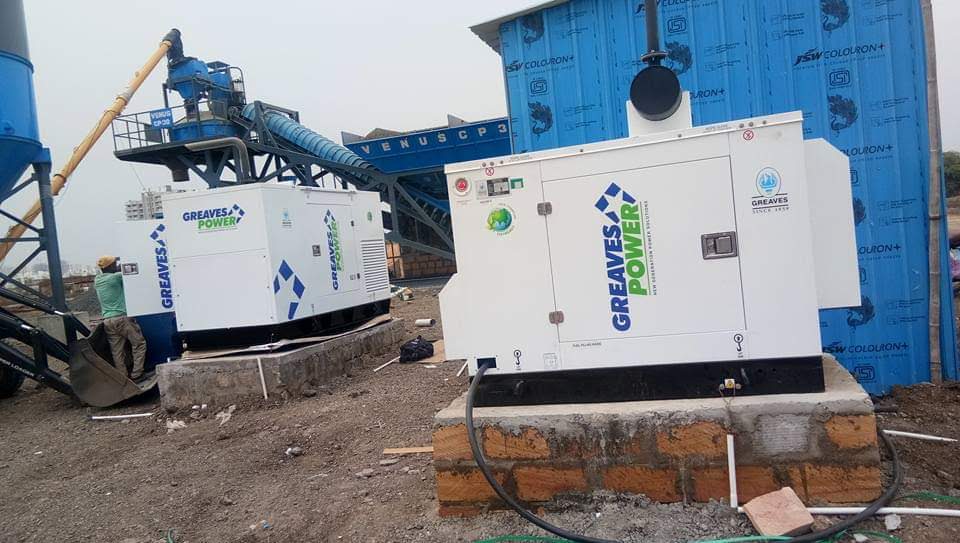
Define responsibility through handover
The installation needs a clear boundary between equipment supply, electrical connection, operation and site supervision. Agree who may add loads or move equipment, who maintains the records and how faults are reported. Include testing and inspection in the programme before the relevant work stage begins. The temporary system should remain suitable as the construction site develops, with changes assessed before additional demand is connected.
Request Rental Power
Request Rental Power. Share the application, location and information available so the next discussion can address your actual requirement.
Related guidance
Engineering intent
Construction-Site Power should be evaluated as part of the complete power system rather than as an isolated catalogue item. Operating duty, connected load, interfaces, protection, controls, installation conditions, testing requirements and lifecycle consequences determine whether the arrangement is appropriate.
Engineering considerations
Do not treat tunnel power as ordinary open-site power. A generator suitable for early site cabins may not suit heavy works or commissioning loads later. Fabrication loads may be intermittent but high impact. These loads may be smaller, but they support site administration, safety and communication. For temporary offices, a compact generator or shared temporary distribution may be suitable, subject to load and site review. Night construction needs lighting that is safe, stable and positioned correctly. Lighting power may look simple, but poor temporary cabling can create safety risks. A single generator plan at project start may become outdated as the site evolves. The temporary distribution system is what delivers usable power to site work.
Selection and design considerations
For construction customers, monitoring supports cost control, fuel control and downtime reduction. Construction projects often prefer rental because site power demand is temporary, phase-based and uncertain. Rental can be economically attractive for construction projects, but the correct power system still requires load, site, cable, fuel and safety review. Commissioning power should be stable, documented and controlled. A commissioning load is not a casual construction load. It may require tighter voltage, frequency, protection and documentation. Construction rental generators should be maintained according to duty and site conditions. Construction sites may need more frequent checks than clean indoor installations due to dust, heat, vibration and high running hours.
Integration and protection considerations
Construction and infrastructure projects often begin before permanent electrical infrastructure is fully available. For construction sites, generator power is not only temporary electricity. It is project execution infrastructure. A finished building usually has defined electrical distribution. That is why construction generator planning must be flexible, staged and site-aware. A construction and infrastructure generator strategy may include:
| Early site establishment | Small/medium rental generator, DBs, lighting |
|---|---|
| Batching plant | Motor, mixer, compressor and pump load planning |
| Tunnelling / metro | Ventilation, pumps, lighting, controls and emergency backup |
| Fabrication yard | Welding, cutting, compressors and heavy tools |
| Night work | Site lighting and fuel/runtime planning |
| Commissioning | Temporary power, load testing and controlled energisation |
| Grid delay | Prime/rental power until permanent supply is available |
Testing, commissioning and verification
Temporary power should leave the site safely and traceably. Each project type requires a different load and site plan. What is the largest motor or crane load? All support remains subject to site access, load details, equipment availability, technician availability, safety conditions, rental fleet status and written quotation. Telecom Power Is Not Just Site Power. It Is Network Continuity. Telecom infrastructure connects people, businesses, hospitals, banks, data systems, public services and emergency communication. A telecom site may look small compared with a factory or hospital, but its power failure can affect a large communication network.
Operating and lifecycle considerations
The site load today is not always the site load next month. For small sites, offices, lighting, tools or limited construction loads. For separate zones, cranes, batching plants or remote work areas. For high capacity, redundancy, staged operation or variable load. For fluctuating loads, noise-sensitive periods or fuel optimisation where justified. For critical pumps, tunnels, safety systems or emergency backup. The correct architecture depends on load, project phase, site layout, access and criticality. It is temporary power engineering, not simple rental. A start-and-run check is not enough for critical construction loads. The rental-power source says future rental contracts may increasingly require transparent reporting of fuel consumed, energy generated, runtime, average loading, carbon emissions, renewable contribution, battery utilisation and fuel savings, making energy performance measurable rather than assumed.
Direct answer
Site demand changes as excavation, structural work, fit-out and commissioning progress. Record the tools, pumps, lifting equipment, welding loads, lighting and temporary facilities that are actually relevant to each stage.
The practical decision for Construction-Site Power should be based on verified load, equipment, interface and site information. Where equipment-specific data, regulatory applicability or a project study is required, this guidance does not replace that verification.