

In short. A generator exhaust system is a high-temperature flow system, not a smoke pipe. It must carry gases at 400 to 550 degrees away from people and buildings while keeping total backpressure within the engine manufacturer’s limit, typically a few kilopascals for a turbocharged diesel. Pipe diameter, length, bends, silencer, any retrofitted emission control device and the stack all consume that allowance, so the system is designed as a sum, not component by component.
What the exhaust system has to do
Combustion gas leaves the turbocharger outlet at high temperature and velocity, pulsing at firing frequency. The exhaust system must move it to a discharge point where it disperses safely, attenuate noise, accommodate thermal expansion, keep heat away from cables, fuel lines and people, drain condensate, and do all of this without restricting the engine. Two sets of the same kVA can have different outlet sizes, flow rates and permitted backpressure, so the design always starts from the selected engine’s data sheet.
Backpressure: the number that governs everything
Backpressure is the pressure the engine must work against to push gas through the system. Excess backpressure raises exhaust temperature, reduces turbocharger efficiency, increases fuel consumption and smoke, and over time damages valves and turbochargers. Manufacturers publish a maximum allowable figure measured at a defined point after the turbine; for turbocharged industrial diesels it is commonly 5 to 10 kPa, but it must be confirmed for the specific engine.
ΔPtotal = ΔPflex + ΔPpipe + ΔPbends + ΔPsilencer + ΔPRECD + ΔPstack and cap
Each ΔP is the pressure loss of one element at the engine’s rated exhaust flow and temperature, and ΔPtotal must stay below the engine limit with a margin for soot build-up. Worked example (illustrative): an engine with a 7.5 kPa limit is fitted with a residential silencer at 2.5 kPa, 12 metres of pipe and four long-radius bends at 1.8 kPa, a bellows at 0.3 kPa and a rain cap at 0.4 kPa, a total of 5.0 kPa. If a retrofitted emission control device rated at 2.5 kPa clean is added, the total reaches 7.5 kPa with no margin, and as the device loads up the engine exceeds its limit. The fix is a larger pipe or a lower-loss silencer, decided before purchase rather than after a high exhaust temperature alarm. Pressure loss in straight pipe rises with velocity squared, so one size up in diameter cuts friction loss by more than half, and four 90 degree bends can cost as much as 20 metres of straight pipe. The calculation method is in exhaust backpressure.
Routing, expansion and support
Steel exhaust pipe grows roughly 1 mm per metre for every 85 K of temperature rise, so a 15 metre run heating by 450 K grows about 80 mm, and that movement must go somewhere. The bellows at the engine absorbs vibration and small misalignment only; it is not an expansion joint and must never carry pipe weight. Pipe hangs from the building on supports that allow axial movement, with an anchor and expansion bellows on long runs. A rigidly bolted pipe pulls on the turbocharger housing and cracks it within a season of daily running. Long horizontal runs fall slightly away from the engine to a drain at the low point.
Heat and clearance
Uninsulated pipe runs above 400 degrees. Insulate with mineral wool and cladding wherever the pipe is within reach of people or near cables, fuel pipes and combustible materials, and sleeve every wall and roof penetration. Insulate the silencer inside the room too, otherwise it adds tens of kilowatts to the ventilation load discussed on the cooling system page.
Discharge location and CPCB stack height
CPCB’s emission regulations for diesel generator sets give a minimum stack height for sets up to 1,000 kVA: the height of the building plus 0.2 multiplied by the square root of the kVA rating, in metres. A 500 kVA set on a 12 metre building therefore needs a stack of about 12 + 0.2 × 22.4, or roughly 16.5 metres above ground (illustrative). Larger sets are treated under industrial stack-height rules, and the State Pollution Control Board may apply its own conditions, so the applicable requirement must be confirmed for the project. Beyond compliance, the discharge should be above and away from any air inlet, window, balcony or neighbouring building, and should not blow across the radiator inlet louvre. The regulatory background is in India genset emissions.
Silencers and noise
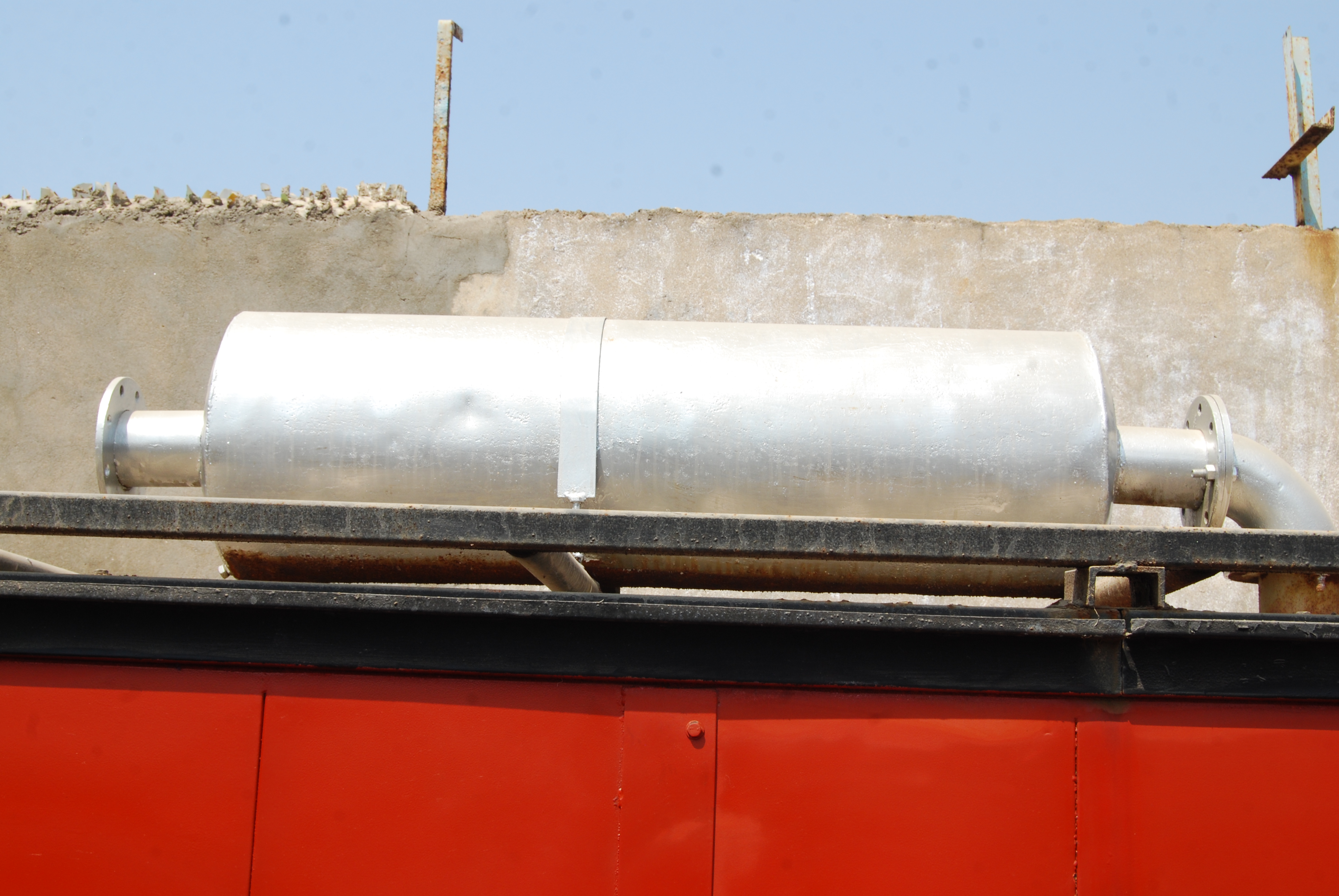
Exhaust pulsation is often the dominant noise source of an open set. Silencers are graded broadly as industrial, residential and critical, with attenuation rising from around 15 dB to 35 dB and pressure loss rising with it, so a larger silencer is not automatically better. Choose the grade from the site noise limit, then check the loss in the sum above. Extending a canopy tailpipe up a building to meet stack height adds loss that the canopy maker did not allow for. See acoustic enclosures for how the exhaust fits into total noise control.
Aftertreatment and RECD retrofits
CPCB IV+ sets carry factory aftertreatment, and older sets in many cities must be fitted with a retrofitted emission control device. Both add pressure loss, both need exhaust temperature within a working window, and both need sensors and periodic cleaning or regeneration. Before any retrofit, measure the existing backpressure at rated load with a manometer at the manufacturer’s measurement point, record load, speed, instrument and configuration, and repeat the measurement on the same basis after installation. The device’s own pressure drop is never compared in isolation with the engine limit; only the complete-system total counts. Our RECD installation and integration guide covers the survey, mounting and monitoring, and emissions and aftertreatment explains the factory systems.
Inspection and verification
| Stage | Check | Pass condition |
|---|---|---|
| Design | Sum of pressure losses at rated flow | Below engine limit with margin for fouling |
| Installation | Flex carries no weight, supports allow movement, insulation and penetrations complete | Pipe can be moved by hand at supports when cold, no load on turbo flange |
| Commissioning | Backpressure measured at 75 to 100 percent load | Within limit, recorded with load, speed and instrument |
| Annual | Corrosion, cracked bellows, condensate drain, rain cap | No water in silencer, drain clear, cap free |
| After any modification | Repeat backpressure measurement | Compared with the pre-modification baseline |
Related photographs and videos
Common mistakes
- Designing the exhaust from the set’s kVA and a generic pipe size table; the real limit is engine-specific and the system can exceed it on paper before it is built.
- Hanging pipe weight on the engine bellows; the bellows splits or the turbocharger housing cracks and the set is off for weeks waiting for a casting.
- Adding an RECD or a bigger silencer without a backpressure baseline; the engine runs hot, smokes and loses power, and the cause is argued about for months.
- Terminating the stack near the radiator inlet or a window; exhaust is drawn back into the room and the set trips on high temperature while occupants complain of fumes.
What to send us
Send the engine nameplate photo, the proposed or existing pipe route with lengths, bends and silencer type, a photo of the turbocharger outlet and bellows, the building height and the nearest openings to the planned discharge. If you are planning an RECD, include any measured backpressure with the load at which it was taken. Send it through the application engineering enquiry; the fuel side of the installation is covered under fuel systems.
Questions engineers ask
What is the maximum exhaust backpressure for a diesel generator?
There is no universal figure. Each engine manufacturer states a limit at a defined measurement point, and for turbocharged industrial engines it is usually a few kilopascals, often between 5 and 10 kPa. Use the figure for your exact engine and keep a margin for soot build-up.
How high should a generator exhaust stack be in India?
CPCB guidance for DG sets up to 1,000 kVA is building height plus 0.2 times the square root of the kVA rating, in metres. The State Pollution Control Board may impose conditions beyond that, and the discharge must also clear nearby air inlets and windows, so confirm the requirement for your site.
Can I extend the exhaust pipe of a silent generator up the building?
Yes, if the added length and bends are counted against the engine backpressure limit together with the canopy’s own silencer. Often the pipe diameter must be increased one size above the canopy outlet, and the extension needs its own supports and an expansion joint.
Why is my exhaust temperature alarm tripping after fitting an RECD?
Most likely the device’s pressure drop pushed total backpressure over the engine limit, or the device is loading with soot faster than expected. Measure backpressure at load and compare with the pre-retrofit baseline and the engine limit before adjusting anything on the engine.
Generators by rating
- Under 15 kVA generators
- 15–50 kVA generators
- 50–125 kVA generators
- 125–250 kVA generators
- 250–500 kVA generators
- 500–1000 kVA generators
- 1–2 MVA generators
- 2 MVA and above generators
Technical content reviewed by Srinivas Reddy, Managing Partner, Reddy Generators. Last updated 19 October 2026.