

In short. An acoustic enclosed generator set is a diesel generator built inside a canopy that attenuates noise, keeps weather out and still lets the engine breathe. In India a new set must meet the CPCB limit of 75 dB(A) at 1 metre, and that figure only means something with load, distance and test method stated. The quietest canopy on paper can overheat in a Hyderabad summer, so airflow, exhaust back-pressure and service access must be checked with the noise claim.
What an acoustic enclosure actually does
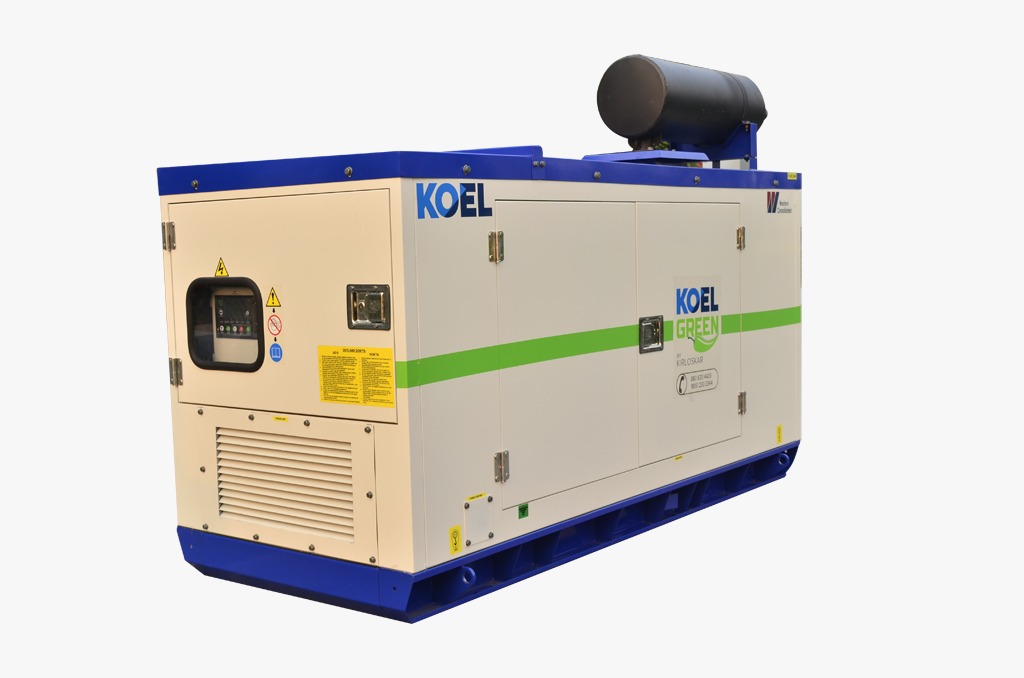
A canopy is not a box placed around a generator. It is a small plant room with its own ventilation, silencing and drainage, shrunk to the footprint of the baseframe. It contains noise from the engine, alternator and fan, keeps out rain and dust, and allows the set to sit on a terrace or in a car-park corner where a generator room would never be permitted.
Everything the enclosure does for noise it does against airflow. Sound leaves through the same openings that cooling and combustion air enter, so every attenuator and louvre adds pressure loss. The design task is to find the opening geometry and lining that give the required insertion loss while the radiator still sees enough air at rated load and the highest ambient the site will experience. A good canopy is judged by its thermal margin as much as by its sound level.
How to read a noise rating
A claim such as “75 dB silent generator” is incomplete. The CPCB norms for diesel generator sets require 75 dB(A) at 1 metre from the enclosure surface under free-field conditions, with a minimum insertion loss of 25 dB(A). Each of those words carries a condition, and a meaningful acoustic statement from any supplier should identify them.
| Element of the claim | What to ask for | Why it changes the number |
|---|---|---|
| Metric | Sound pressure level in dB(A), or sound power level | Sound power is usually 8 to 10 dB higher than pressure at 1 m |
| Distance | 1 m from the canopy surface, or 7 m, or 15 m | Each doubling of distance drops the level by about 6 dB in open air |
| Load | Percentage of rated load during the test | Fan speed, combustion noise and exhaust flow all rise with load |
| Environment | Free field, or reflecting walls nearby | A canopy against a wall can read 3 dB higher |
Ask for the type-test certificate for the canopy model, compare its conditions with your site, and measure after installation at the point that matters, usually a boundary or a neighbour’s window.
Cooling air is the limiting resource
The radiator fan must pull air through the inlet attenuator, across the engine, through the radiator core and out through the discharge attenuator. The canopy adds static pressure to that path. If the pressure loss exceeds what the fan can overcome, airflow falls, the air inside the canopy heats up, and the engine sees hotter combustion air and a radiator working against a smaller temperature difference.
Q = H / (ρ × cp × ΔT)
Here Q is the ventilation airflow in cubic metres per second, H is the heat radiated into the canopy by the engine, alternator and exhaust in kW, ρ is air density (about 1.1 kg/m³ at 40 °C), cp is the specific heat of air (about 1.005 kJ/kg K) and ΔT is the allowable rise of canopy air above ambient. For a 125 kVA set radiating about 18 kW into the canopy with a permitted rise of 10 K, Q is roughly 1.6 m³/s before any radiator airflow is counted (illustrative). The radiator needs several times that quantity, which is why the discharge opening on a well-made canopy is large and must never face a wall closer than the manufacturer’s clearance.
A canopy tested at 25 °C in a factory loses part of its margin at 45 °C on an unshaded terrace in Telangana. Ask for the maximum ambient at which the enclosed set delivers full rating, and read ambient temperature derating before accepting a nameplate.
Exhaust silencing and back-pressure
Exhaust pulsation is often the dominant source once engine noise is contained. A residential grade silencer gives more attenuation than an industrial one, but it does so by adding restriction. Every diesel engine has a maximum permissible exhaust back-pressure, and exceeding it raises exhaust temperature, costs power and shortens turbocharger and valve life. On a CPCB IV+ set the aftertreatment adds its own pressure drop, so the silencer, bends and tailpipe must be selected with less allowance than before. The arithmetic is on the exhaust back-pressure page and should be done whenever the tailpipe is extended to clear a parapet or reach a stack.
Construction details that decide lifespan
Most canopies in the Hyderabad market are CRCA sheet, powder coated after pre-treatment, lined with mineral or glass wool behind perforated sheet. The differences show up after three monsoons.
- Panel thickness and stiffening, because thin panels drum at engine firing frequencies and undo the lining’s work.
- Door seals and latches, because a door that does not compress its gasket leaks noise and lets in rain.
- Lining protection, because exposed wool absorbs water, sags and loses attenuation.
- Lifting points and removable roof or side panels, because a top overhaul with the engine inside is slow if the canopy was not designed for it.
Access deserves a separate word. A canopy that puts the fuel filter behind the alternator will be serviced less often than it should be. Walk round it with the service technician before buying, open every door and ask where each routine task is done. The acoustic enclosure page covers the component level in more depth.
Canopy or generator room
An enclosed set and an open generator set in a purpose-built room produce the same electricity; the choice is about where the acoustic engineering is done. A canopy suits sites with no room available, relocatable sets and capacities up to a few hundred kVA. A room is usually better above about 750 kVA, where several sets share fuel and switchgear, or where the building already exists. Either way the noise target at the boundary must be set first, as the acoustic engineering page explains.
Related photographs and videos
More related media (2)
Common mistakes
- Placing the radiator discharge face within a metre of a compound wall, so hot air recirculates to the inlet. The engine then runs hot at loads it should carry easily and trips in summer.
- Accepting a dB(A) figure without the distance and load stated. The set measures far louder at the neighbour’s window than the brochure suggested, and a complaint follows.
- Extending the tailpipe with several bends and no recalculation of back-pressure. Exhaust temperature rises and the turbocharger fails early.
- Choosing a canopy by price per kVA and ignoring access. Routine service takes twice as long, so it is skipped, and the set fails when it is needed.
What to send us
Send the kVA you need or your load list, photographs of the proposed location showing the nearest walls, windows and boundary, and whether the set will sit at ground level or on a terrace. Tell us the noise limit you must meet if a consent or landlord condition specifies one. If you are replacing an existing set, a nameplate photograph and a note of any overheating or noise complaints help us select the right canopy grade. Use the generator sales enquiry form and we will respond with options and an installation sketch.
Questions engineers ask
Is a 75 dB(A) canopy quiet enough for a residential apartment compound?
75 dB(A) at 1 metre is the CPCB manufacturing limit, not a comfort level. At 10 to 15 metres in open air the level falls to the low 50s, which is acceptable in most compounds by day, but reflections and the discharge direction can add several dB. Point the discharge away from windows and consider a residential grade silencer if the set runs at night.
Does the canopy reduce the generator’s rated output?
Not if the canopy was designed and tested with that engine and the site ambient is within the manufacturer’s limit. If the canopy is a third-party retrofit, or the site is hotter than the test condition, the set may not deliver its nameplate continuously. Ask for the enclosed rating at 45 °C or 50 °C.
Can I install an enclosed set on a terrace?
Yes, provided a structural engineer checks the slab for the operating weight, vibration isolators are fitted, the discharge air has a clear path, the exhaust clears the parapet and nearby air-conditioning inlets, and fuel can be delivered safely.
How much clearance does an acoustic canopy need around it?
Manufacturers typically ask for at least 1 metre on the door sides for service and 2 to 3 metres on the radiator discharge face to prevent recirculation. Follow the drawing for the specific model; the clearance grows with kVA.
Generators by rating
- Under 15 kVA generators
- 15–50 kVA generators
- 50–125 kVA generators
- 125–250 kVA generators
- 250–500 kVA generators
- 500–1000 kVA generators
- 1–2 MVA generators
- 2 MVA and above generators
Technical content reviewed by Srinivas Reddy, Managing Partner, Reddy Generators. Last updated 19 October 2026.