
AMF Detects the Problem and Starts the Response.
Automatic Mains Failure logic monitors the normal electrical source and coordinates generator response when defined abnormal conditions occur.
AMF FUNCTION
Related photographs and videos
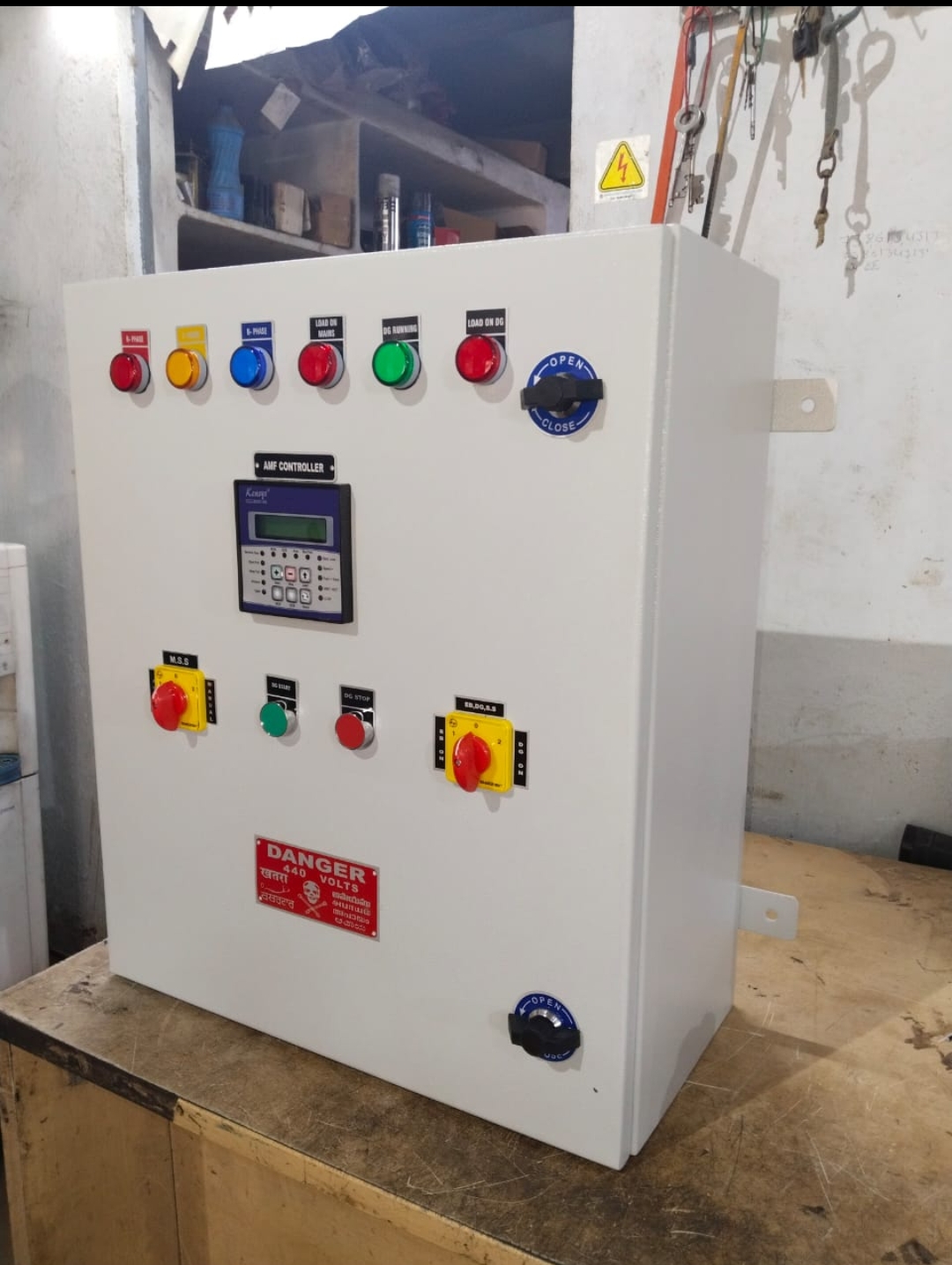

MONITOR MAINS
- abnormal condition detected
- condition confirmed
- generator start
- generator output verified
- transfer enabled
- generator operation monitored
- normal source restored
- retransfer
- cooldown
- stop.
WHAT AMF MONITORS
Depending on system design:
- voltage
- frequency
- phase conditions
- source availability.
AMF ≠ ATS
AMF decides and coordinates.
ATS switches the power path.
Some equipment may combine both functions physically, but the engineering functions remain distinguishable.
DELAYS MATTER
System logic may use:
- failure-confirmation delay
- start delay
- warm-up
- transfer delay
- restoration delay
- cooldown.
These values must be selected for the application.
COMMON FAILURE AREA
A healthy generator does not guarantee a healthy automatic standby system.
Failure may exist in:
- sensing
- control power
- start circuit
- transfer logic
- breaker
ATS.
Automatic backup begins with accurate sensing and disciplined control logic.
Engineering intent
AMF Panels should be evaluated as part of the complete power system rather than as an isolated catalogue item. Operating duty, connected load, interfaces, protection, controls, installation conditions, testing requirements and lifecycle consequences determine whether the arrangement is appropriate.
Control-system requirement
The control architecture must connect sensing, source readiness, permissives, breaker or transfer commands, feedback, alarms, communications and fallback modes. An individual component test does not prove the complete operating sequence.
Engineering considerations
Local, remote, BMS, SCADA, modem or gateway where installed. Start delays, attempts, alarms, shutdowns, cooldown and communication mapping. Manual, auto, alarm, shutdown, breaker and communication functions as applicable. If the controller model is known but the system behaviour is unknown: AMF decides and coordinates. ATS switches the power path. Some equipment may combine both functions physically, but the engineering functions remain distinguishable. A generator that starts but never reaches the load is still a backup-power failure. Automatic Backup Is Not Just Generator Starting. It Is Source Detection, Decision Logic and Safe Load Transfer. But if the load never transfers, the facility still has a backup-power failure. They coordinate how a facility detects source failure, starts the generator, verifies generator availability, transfers the load, monitors generator operation, returns to normal source and leaves the generator ready for the next event.
Selection and design considerations
Start Is Not Continuity. Transfer Is Not Assumption. The Sequence Must Be Engineered. ATS and AMF systems are the control and switching arrangements that support automatic standby generator operation. The objective is not merely to start the generator. The objective is to restore the defined load safely according to the approved sequence. AMF logic detects abnormal normal-source conditions and coordinates generator response. ATS switches the electrical power path between the normal source and alternate source. Is the load isolated from the unavailable source? Some panels or packaged systems may combine AMF logic and transfer switching in one equipment assembly. But even when physically combined, the engineering functions remain separate: This distinction prevents incorrect troubleshooting and unsafe assumptions.
Integration and protection considerations
A short disturbance should not always trigger a full generator event. Some systems may use a failure-confirmation delay to confirm that the normal source condition is truly unacceptable. But delay values must be selected for the application. Do not assume one universal delay time for all facilities. Start delay may be used to coordinate generator response after detected source failure. False starts and nuisance operation can also create problems. The command path must be wired, tested and documented. A generator that starts locally has not proven it will start from the AMF/ATS system. Do not repeatedly crank the generator without diagnosis.
Testing, commissioning and verification
Voltage, frequency and phase conditions are observed according to design. A delay or logic condition may prevent nuisance starting. Voltage and frequency must be acceptable before transfer. Transfer is permitted only when required conditions are met. The load is connected to the generator source. Generator and system conditions continue to be supervised. The system confirms that normal source is stable again. The load returns to normal source according to approved logic. The generator runs unloaded or under defined condition as required. The system becomes available for the next event. The exact sensing method depends on the controller, panel and project design. Automatic backup begins with accurate sensing and disciplined control logic.
Operating and lifecycle considerations
The shedding scheme should be documented and tested. A healthy generator does not guarantee a healthy automatic standby system. Automatic backup should be tested as a sequence, not assumed from the generator alone. 2 — Generator Starts but Load Does Not Transfer Possible ATS, permissive, interlock, breaker or feedback issue. Generator output or timing logic may be incorrect. Electrical logic may command transfer, but switching does not occur. The system believes the ATS is in one position while the actual state differs. The equipment is healthy but unavailable for automatic operation. But monitoring does not automatically mean remote control, guaranteed response or automatic repair. If the event failed, the timestamps may show where the chain broke.
Decision and application considerations
No universal voltage or frequency threshold should be published across every system. Do Not Start the Generator for Every Tiny Disturbance If the generator responded immediately to every momentary deviation, the installation could experience: Automation can therefore use a failure-confirmation delay or other defined logic before declaring the normal source unacceptable. Once the abnormal condition is confirmed, the automation system can issue a generator-start command. But the start command is only the beginning. Automatic-generator reliability therefore depends on mechanical and electrical readiness as well as software logic. Issuing the start command does not prove successful generation. The system may need to verify appropriate generator operating conditions before proceeding.
Direct answer
AMF Detects the Problem and Starts the Response. Automatic Mains Failure logic monitors the normal electrical source and coordinates generator response when defined abnormal conditions occur.
The practical decision for AMF Panels should be based on verified load, equipment, interface and site information. Where equipment-specific data, regulatory applicability or a project study is required, this guidance does not replace that verification.