

In short. Hoses, belts and seals are cheap parts with expensive failure modes: a split coolant hose or a thrown fan belt shuts a generator down on high temperature within minutes. Each must match the engine reference, the fluid, the temperature and the movement it sees, not just the dimensions. The failed part is evidence, so read its condition before fitting a replacement and fix the cause of repeated failure.
What these parts do on a diesel generator
Drive belts transmit power from the crankshaft pulley to the radiator fan, the water pump and the charging alternator. Coolant hoses join the engine to the radiator and expansion tank and must flex with engine vibration. Fuel hoses carry diesel from the day tank and return excess to it. Air hoses connect the air filter, turbocharger and charge-air cooler. Seals and gaskets keep oil, coolant, fuel and exhaust where they belong. Each is a small part, but each sits in a system whose failure stops the set, which is why belts and hoses feature in every preventive maintenance visit.
Matching the part to its duty
| Part | What must match | Why a lookalike fails |
|---|---|---|
| V-belt or poly-V belt | Profile, length, rib count, construction | Wrong profile rides badly in the groove and slips or overheats |
| Coolant hose | Bore, shape, reinforcement, temperature rating, coolant compatibility | Plain rubber softens with glycol coolant and collapses on suction side |
| Fuel hose | Diesel-resistant inner tube, pressure rating, fittings | Non-fuel rubber swells and sheds particles into the injection system |
| Charge-air hose | Temperature and pressure rating, often silicone with reinforcement | Ordinary hose balloons and splits under boost |
| Gaskets | Engine reference, material, thickness, layers | Wrong thickness changes clearances or crush; wrong material leaks |
| O-rings and shaft seals | Size plus elastomer (nitrile, Viton), lip design, direction | Wrong elastomer hardens or swells; a reversed lip seal leaks immediately |
The engine maker’s part reference is the safest basis. Where it is not available, measurement plus the material and temperature requirement are needed, and the match should be recorded as conditional on that information (photographs sent through Find My Generator Part help), as described on parts compatibility verification.
Belts: tension, alignment and wear
A belt slips when it is loose, and slipping glazes the belt and the pulley groove, overheats both and lets the fan and water pump run slow at exactly the time the engine needs cooling. Overtightening is just as harmful because it loads the water pump and alternator bearings. Set tension with a gauge or the maker’s deflection figure, check again after the first hours of running, and change multiple belts on one drive as a matched set. Inspect for cracking across the ribs, glazing, frayed edges and oil contamination. A belt that wears on one edge or turns over in the groove points to pulley misalignment or a worn tensioner bearing, and a new belt will fail the same way unless that is corrected.
Hoses: what ageing looks like
Coolant hoses age from the inside, so the outside can look acceptable while the inner tube is cracking. Squeeze each hose when the engine is cold: a healthy hose is firm and springs back, while a failing hose feels soft, spongy or crunchy. Look for swelling near clamps, cracks at the bends, oil softening on hoses near the turbocharger, and chafing where a hose touches a bracket. Replace hose clamps with the hose, and use the type the engine maker specifies, because constant-tension clamps follow the hose as it contracts on cooling, which worm-drive clamps do not. In Telangana summers the heat in an acoustic enclosure ages hoses faster than the nominal interval suggests.
Seals and gaskets: leaks as diagnostic evidence
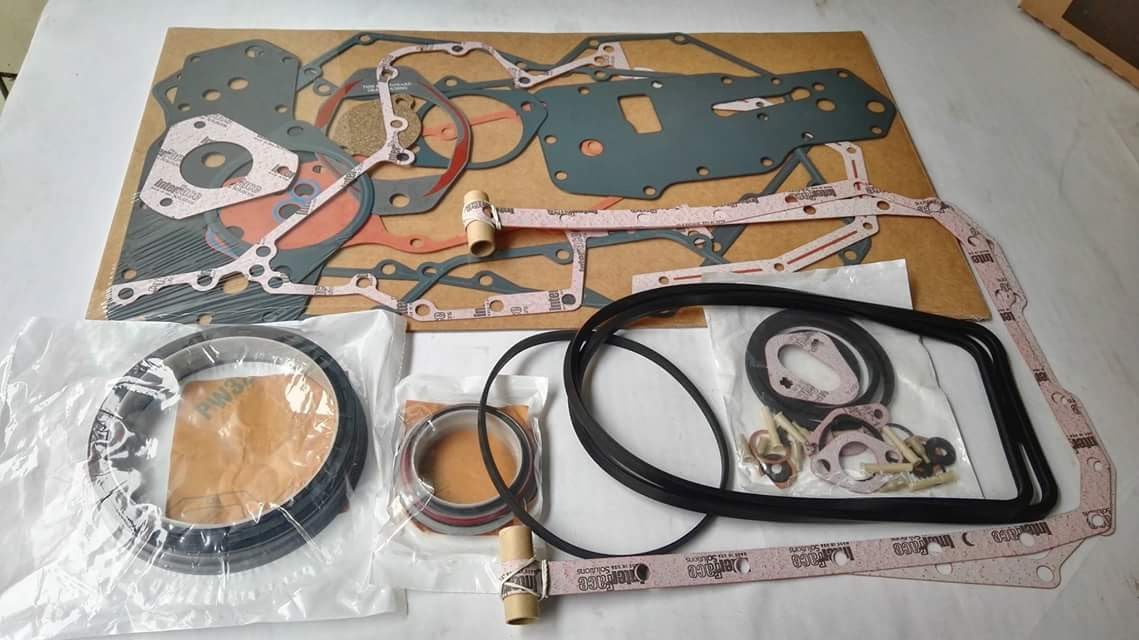
A leak tells you where to look and often why. Oil weeping from a crankshaft seal can be seal wear, but it can also be crankcase pressure from blow-by on a worn engine pushing oil past a healthy seal. A rocker cover gasket that leaks soon after replacement may have been over-tightened or fitted to a warped cover. A head gasket that fails repeatedly suggests overheating, a distorted head or incorrect bolt torque sequence. Replacing the seal without checking these causes resets the clock and little else. Fit seals with the correct installation tool, lubricate lips as specified, and never reuse a gasket or copper washer on a pressure joint. Heavier engine work is described on overhaul kits.
Replacement intervals and stocking
Engine makers specify belt and hose inspection at every service and replacement at defined hours or years, whichever comes first. For standby sets that run few hours, the calendar limit usually decides, because rubber ages with time and heat whether the engine runs or not. Sites with several gensets of the same model gain from stocking one set of belts and the main coolant hoses, chosen by failure consequence, lead time and shelf life. Store rubber parts cool, dark and away from ozone sources such as motors and welding sets.
Related photographs and videos
Common mistakes
- Fitting a generic hose of the right bore but the wrong rating; it softens with coolant or collapses on suction and the engine overheats.
- Changing one belt of a matched pair; the new belt carries all the load, stretches, and both slip.
- Tightening a slipping belt without checking pulley alignment; bearings fail on the water pump or alternator.
- Replacing a leaking crankshaft seal on an engine with heavy blow-by; the new seal leaks in weeks because crankcase pressure is the cause.
What to send us
Send the engine nameplate and serial number, a photograph of the failed hose, belt or seal in place and removed, and any part number moulded or printed on it. Describe where the failure occurred, whether it has happened before and the hours run since the last replacement. Send a spare parts enquiry.
Questions engineers ask
How often should generator belts and hoses be replaced?
Inspect at every service and follow the engine maker’s replacement interval in hours or years. On standby sets that run little, the years limit usually comes first because rubber ages with heat and time.
Can I use automotive belts on a generator engine?
Only if profile, length and construction match the engine maker’s specification. Generator fan drives run continuously at full speed and need belts rated for that duty.
Why does my new fan belt squeal?
Squeal usually means slip from low tension, a glazed pulley, oil contamination or misalignment. Correct the cause rather than applying belt dressing, which attracts dirt and hides the problem.
Is a small oil leak worth stopping the set for?
Not usually immediately, but it should be traced and logged. Oil on hoses and belts damages them, and a leak near the exhaust is a fire risk that needs prompt attention.
Technical content reviewed by Srinivas Reddy, Managing Partner, Reddy Generators. Last updated 19 October 2026.